Showing posts with label separation techniques. Show all posts

Monday, October 7, 2019

Separation of Components of Air

Air is a homogeneous mixture of various gases. It can be separated into its components by fractional distillation. 

Procedure:
  1.  First, the air is compressed and cooled by applying pressure and decreasing temperature. The air will convert to liquid air
  2.  Then, the liquid air is allowed to warm up in the fractional distillation column.
  3.  The gases will be collected at different heights.
A typical example of separation of carbon dioxide, Nitrogen, argon and oxygen gases is shown below:

Friday, March 8, 2019

Sublimation

Sublimation is a process in which solid is directly change into gas state without passing through liquid state. The substances which shows the process of sublimation are known as sublimate.
Examples of sublimate: Camphor, ammonium chloride, naphthalene etc.
Process: Sublimation is a technique used by chemists to purify compounds. A solid is typically placed in a
sublimation apparatus and heated under vacuum. Under this reduced pressure, the solid volatilizes and condenses as a purified compound on a cooled surface, leaving a non-volatile residue of impurities behind. Once heating ceases and the vacuum is removed, the purified compound may be collected from the cooling surface. 

Characteristics:
  1. Sublimation is an endothermic process, i.e., heat is taken up from the surrounding for the phase transition.
  2. Sublimation is a physical change and not a chemical change. For example, decomposition of ammonium chloride on heating to ammonia and hydrogen chloride is a chemical reaction and not sublimation. Also, combustion of hydrocarbons to carbon dioxide gas and water vapour is not sublimation.
Advantages:
  1. Fast
  2. Cheap

Disadvantages:
  1. Non-sublimate compounds may decompose under heating.
  2. Recovery may not be complete- the fumes may be blown away.

Wednesday, March 6, 2019

Sieving

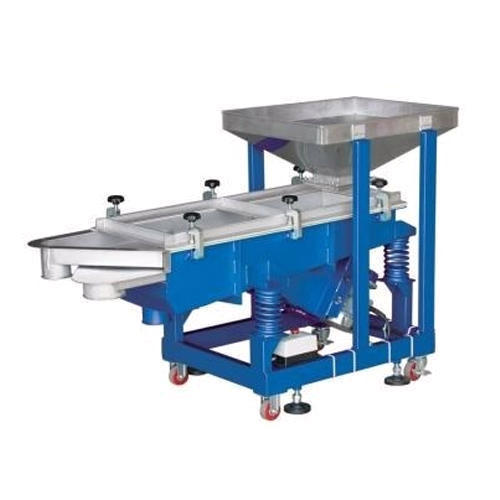
Sieving is a separation technique in which unwanted particles are separated from the desired product on the basis of difference in the particle size of the two components of the mixture.
Common example is separating flour from unwanted material by passing it through a sieve. 


Sieve is the device which has small holes in it. Fine particles can easily pass through it, leaving behind coarse bigger particles.

A sieve can be operated by hands, as in our homes, and also can be used with the help of machines. In latter case, a large-sized sieve is connected to a machine which help in vibrating or moving the sieve. 

A strainer is a form of sieve used to separate a solid from a liquid. For example, separating tea leaves from tea.

Advantages:
  1. It can be used to separate large amount of mixture when operated using a machine.
  2. Easy handling
  3. Saves time
  4. Results are accurate and reproducible.
Disadvantages:
  1. Consumes large amount of electrical energy, when operated using machine. Otherwise, it is a cheaper process.
  2. It works only with dried mixture.

Sunday, February 24, 2019

Separating Funnel

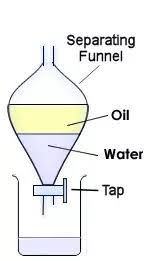
Separating funnel is a apparatus used in chemistry lab for separating two immiscible liquids.

Principle: The liquids to be separated differ in their densities. The more denser or heavier liquid makes the lower layer while the less denser liquid makes the upper layer.

Process: The two liquids are poured in the separating funnel and shaken sideways. Then, it is kept still for some time. The two liquids will start forming two layers. When the layers are fully separated, knob of the separating funnel is opened (a beaker/collector should already be placed ). The lower layer is collected in the collector. As soon as the first layer is poured completely in the collector, knob should be closed. Now, the denser layer has been collected into the collector and the lighter layer remains in the separating funnel.

Experimental procedure with an example:
Let us suppose that we need to separate oil and water.
  1. Pour the mixture of oil and water in the separating funnel, close it with the lid, and shake it well. (Not too vigorously)
  2. Keep it still for some time, say 5 min. ( You can place it on a tripod or burette stand.)
  3. When the 2 layers get separated, place a beaker/conical flask underneath it, and open the knob of the separating funnel.
  4. Collect the lower layer (water layer) in the beaker/conical flask.
  5. When the lower layer is completely poured, close the knob.
  6. Now, the water is collected in beaker and oil remained in the separating funnel.
Other examples: water + organic solvents (dichloromethane, chloroform, ethyl acetate) etc.

Advantages: 
  1. Easy to handle
  2. Saves time
Disadvantages:
  1. The process is not 100% efficient. A small amount of lower layer kept in the separating funnel.
  2. It can separate only immiscible liquids which differ in their densities.

Friday, February 22, 2019

Winnowing

Winnowing is the method in which heavier particles are separated from lighter particles by using wind/blowing air.
This technique is used most commonly when we need to separate the grains from chaff. Mostly used by farmers or people associated with wheat or flour businesses.

Process: Grains collected from the fields contains dirt, dust, husk, chaff, etc along with grains. First of all, chaff is separated from the grains by the process of threshing. Then, the grains are dropped from a height. The lighter particles are carried away from wind while the heavier particles fall vertically downward.


Advantages:
  1. No machinery is needed.
  2. With modern technologies, table fans can be used for this process, if air is not blowing.
  3. It is a cheap method.
  4. It is less time-consuming.

Disadvantages:
  1. Wind or blowing air is needed.
  2. The process is useful only when the weight of the substance is such that wind can move it. For example, if we have to separate small stones from grains, then stones being heavier, will not be carried away by the wind.

Saturday, February 9, 2019

Hand Picking

Hand picking is a method of separation in which components of a solid-solid mixture can be separated simply by picking a particular component by hands. This method is carried out in dry conditions, i.e., no liquid solvent is needed.
This method is generally used to separate the impurity which needs to be removed from the mixture.
The substance in hand picking can be separated on the basis of colour, size, shape, weight, etc.

It is a method which is very commonly used even in our houses. Our mother cleans rice, pulses grains, etc. by this method. But this method is useful only when the mixture to be separated is in small quantity.

Refresh
Other examples: 
1. Separating rotten vegetables from good ones
2. Separating red grams from rice
3. Separating green grapes from black grapes.
Advantages:
1. Less time-consuming
2. Doesn't need any special machine or skill
Disadvantages:
1. Possible with only small quantities
2. Components should be distinguishable, i.e., there should be difference in physical appearance of the components.

Thursday, February 7, 2019

Separation of Components of a Mixture

Is matter pure??

For a common man, purity means that there is no adulteration in the matter.
But for scientists, purity means that all the constituent particles of that substance are same in their chemical nature.
Example: It is written "pure" on milk packs. Here, pure means no adulteration is done, but milk itself is a mixture of fats, proteins, water, etc. Hence, a chemist doesn't consider milk as pure.
*image taken from google.
For a chemist, it is necessary to separate components of a mixture. The separation of the components makes it possible to study and use the individual components of a mixture.

In a mixture, solute and solvent can exist in following pairs:
1. Solid-solid
2. Solid-liquid
3. Liquid-liquid
4. Gas-gas
(Though we have more combinations, but the separation techniques that we use comprises mainly of these pairs)

Solid-Solid

Hand picking: Use to separate heterogeneous mixture by simple physical method.
Threshing: Generally use to separate grain seeds from their stalks.
Winnowing: use to separate heavier and lighter components by wind or blowing air.
Sieving: use to separate fine particles from bigger particles of a mixture by passing through a sieve.
Sublimation: Use to separate the mixture in which 1 of the components can sublimate.
Magnetic separation: Used to separate the mixture in which 1 of the components is of magnetic nature like iron filings.

Solid-liquid

Crystallisation: A supersaturated solution is allowed to cool down and crystals of pure solid separates out.
Evaporation: Use to separate the volatile component (solvent) from its non-volatile solute.
Sedimentation and decantation: In this, heavier components settle after water is added and then water along with lighter impurities is poured into another container.
Filtration: Components of size greater than 100 nm cannot pass through filter paper and hence can be separated using filter papers.
Chromatography: Used for separation of those solutes that dissolve in the same solvent.
Churning (or centrifugation): In this, the denser particles are forced to the bottom and the lighter particles stay at the top when spun rapidly.

Liquid-liquid

Distillation: Use for separation of components of a mixture containing two miscible liquids that boil without decomposition and have sufficient difference in their boiling points.
Fractional distillation: Temperature difference between 2 miscible liquids is less than 25 K.
Using separating funnel: The immiscible liquids separate out in layers depending on their densities.

Gas-gas

Separation of components of air: Consecutive freezing and fractional distillation is done.


When more than 2 components are present, a combination of various techniques can be used. For example, for separating a mixture of ammonium chloride, salt and sand, we can first heat the mixture in China dish, ammonium chloride will sublimate and get separated. Next, add water to the mixture of sand and salt. Salt will dissolve and sand remain as it is. Filter the sand. Now, you are left with only salt solution. Evaporate water and you will get salt crystals. Hence, all the components of a mixture are separated.

Separation of Components of Air

Air is a homogeneous mixture of various gases. It can be separated into its components by fractional distillation.  Procedure:  Firs...