Showing posts with label General chemistry. Show all posts

Thursday, February 7, 2019

Separation of Components of a Mixture

Is matter pure??

For a common man, purity means that there is no adulteration in the matter.
But for scientists, purity means that all the constituent particles of that substance are same in their chemical nature.
Example: It is written "pure" on milk packs. Here, pure means no adulteration is done, but milk itself is a mixture of fats, proteins, water, etc. Hence, a chemist doesn't consider milk as pure.
*image taken from google.
For a chemist, it is necessary to separate components of a mixture. The separation of the components makes it possible to study and use the individual components of a mixture.

In a mixture, solute and solvent can exist in following pairs:
1. Solid-solid
2. Solid-liquid
3. Liquid-liquid
4. Gas-gas
(Though we have more combinations, but the separation techniques that we use comprises mainly of these pairs)

Solid-Solid

Hand picking: Use to separate heterogeneous mixture by simple physical method.
Threshing: Generally use to separate grain seeds from their stalks.
Winnowing: use to separate heavier and lighter components by wind or blowing air.
Sieving: use to separate fine particles from bigger particles of a mixture by passing through a sieve.
Sublimation: Use to separate the mixture in which 1 of the components can sublimate.
Magnetic separation: Used to separate the mixture in which 1 of the components is of magnetic nature like iron filings.

Solid-liquid

Crystallisation: A supersaturated solution is allowed to cool down and crystals of pure solid separates out.
Evaporation: Use to separate the volatile component (solvent) from its non-volatile solute.
Sedimentation and decantation: In this, heavier components settle after water is added and then water along with lighter impurities is poured into another container.
Filtration: Components of size greater than 100 nm cannot pass through filter paper and hence can be separated using filter papers.
Chromatography: Used for separation of those solutes that dissolve in the same solvent.
Churning (or centrifugation): In this, the denser particles are forced to the bottom and the lighter particles stay at the top when spun rapidly.

Liquid-liquid

Distillation: Use for separation of components of a mixture containing two miscible liquids that boil without decomposition and have sufficient difference in their boiling points.
Fractional distillation: Temperature difference between 2 miscible liquids is less than 25 K.
Using separating funnel: The immiscible liquids separate out in layers depending on their densities.

Gas-gas

Separation of components of air: Consecutive freezing and fractional distillation is done.


When more than 2 components are present, a combination of various techniques can be used. For example, for separating a mixture of ammonium chloride, salt and sand, we can first heat the mixture in China dish, ammonium chloride will sublimate and get separated. Next, add water to the mixture of sand and salt. Salt will dissolve and sand remain as it is. Filter the sand. Now, you are left with only salt solution. Evaporate water and you will get salt crystals. Hence, all the components of a mixture are separated.

Tuesday, February 5, 2019

Mixtures

The matter, we see around us, can be classified into 2 categories:
1. Pure substance
2. Mixture.

Pure Substance

A pure substance consists of a single type of particles. Hence, it cannot be separated into other kinds of matter by any physical process.

Mixture

Mixtures are constituted by more than one kind of pure form of matter.The constituents are mixed in any proportion. Hence, mixtures has no chemical formula.
Example: Sugar can be separated from a sugar solution via evaporation. However, sugar itself is a substance which cannot be separated into its chemical constituents by physical process.

Mixtures can be separated by physical methods.
Depending upon the composition of the constituents, we can have 2 types of mixtures.
Homogeneous: solute and solvent together form 1 phase and no physical boundary is visible.
Heterogeneous: solute and solvent forms distinct phase and can be distinguished easily.

Characteristics of Mixtures

The characteristics of mixtures are given below:
  1. Mixture has no fixed composition.
  2. Energy is neither produced nor evolved while forming a mixture.
  3. Mixture has no fixed melting point and boiling points.
  4. Mixture retain the properties of its components.
  5. Components of mixtures can be separated by simple physical methods.

Types of Mixtures

Solution
A solution is a homogeneous mixture of two or more substances. For example, lemonade, soda water, alloys, air, etc.

Colloid
Colloid is a heterogeneous mixture of two or more substances. Due to the relatively smaller size of particles, as compared to suspension, the mixture appears to be homogeneous. For example, milk, fog, jelly, etc.
We cannot see colloidal particles but these particles scatter light. This scattering of light is called the Tyndall effect.

Suspension
A suspension is a heterogeneous mixture in which the solute particles do no dissolve but remain suspended throughout the bulk of the medium. Particles of a suspension are visible to the naked eyes.

Purity of Matter:
Matter around us is not pure. There us various techniques which are used to separate the components of mixtures like, hand picking, winnowing, centrifugation, distillation, chromatography, etc.

Thursday, January 24, 2019

Characteristics of Matter

We have already introduced matter. Matter is anything which has mass and occupy space. We can perceive matter from our 5 sensory organs, i.e., eyes, ears, tongue, nose and skin.
Now, let us discuss about the characteristics of this matter. 

1. Matter is made up of particles.
Matter is made up of still smaller particles which are known as atoms. Hence, it is particulate and is not continuous in nature.
Atom is the basic unit of any matter. Atoms are so small that we cannot see it even through the strongest microscope available, in present.

2. Particles are constantly moving.
All the particles are associated with kinetic energy. Due to this energy, they always remain in motion.
Kinetic energy varies proportionally with square of temperature (i.e., K = 1/2 kT2) and hence, the speed of particles also increases with temperature.

3. They have space in between them.
When we add sugar crystals to water and stir it, we observe that after some time the crystals disappear. The large sugar crystals keep on dividing themselves into smaller and smaller particles and goes into the space in between the water molecules. This shows that there is a lot of space between particles of matter.

4. They are very small in size.
As discussed, atoms are very small in size. The radius of an atom ranges between 10-10-10-11 m.
You must have noticed that 1 crystal of salt is so small that we can't see it with our naked eyes. Even that 1 small crystal of salt consist of millions of tiny particles. From this you can conclude that particles of matter are very small.

5. They attract each other.
There are forces in between particles of different matter. These forces keep different particles together. This force is different for solids, liquids and gaseous matter.

Saturday, December 15, 2018

Rydberg Polaron

Rydberg Polaron is a very recently discovered state of matter. It is now known as 6th state of matter.
This state was predicted by theorists in 2016 at TU Wein (Vienna) and Harvard University, and is confirmed at Rice university in Houston (Texas) in 2018 by using the spectroscopic techniques.

Scientists used two fields of atomic physics to establish this state, i.e., Bose-Einstein condensate and Rydberg atoms.
Bose-Einstein condensate is 5th state of matter that exists at very low temperature, near to absolute zero. 
Rydberg atom are those in which an atom is send to excited state. In this state, electron will be far away from the nucleus. As a result, a lot of space is left empty in which many atoms can fit. In this, many atoms are fitted in between the nucleus and the electron of other atom.

How it is made?

First, a Bose-Einstein state was created with a strontium atom. Then, using a laser, energy is transferred to one of the strontium atoms to turn it to the Rydberg atom with a very large atomic radius. In other words, we can say that this atom is in excited state where the electron is far away from the reach of nucleus and very small effect of nucleus is shown on the electron. The radius of this atom is much bigger than the radius for usual atom. At this point, the electron revolves in its own orbit and the other strontium atom lies inside this orbit (between the Rydberg nuclei and the last shell). 
Depending upon the radius of this newly created Rydberg atom, more than 170 other atoms can fit into it.

Stability?

Computer simulations show that a weak interaction decreases the total energy of the system and a bond is formed between the Rydberg atom and other atoms. The bonds between the Rydberg atom and other strontium atom is much weaker as compared to bonds in other crystal systems. If the particles were moving any faster, the bond has broken and we will not be able to detect this state.
First, a Bose-Einstein condensate was created with strontium atoms. Using a laser, energy was transferred to one of these atoms, turning it into a Rydberg atom with a huge atomic radius. The radius of the orbit in which the electron moves around the nucleus is much larger than the typical distance between two atoms in the condensate. Therefore, the electron orbits its own atomic , while numerous other atoms lie inside its orbit, too. Depending on the radius of the Rydberg atom and the density of the Bose-Einstein condensate, as many as 170 additional strontium atoms may be enclosed by the huge electronic orbit.

Read more at: https://phys.org/news/2018-02-creation-rydberg-polarons-bose-gas.html#jCp
First, a Bose-Einstein condensate was created with strontium atoms. Using a laser, energy was transferred to one of these atoms, turning it into a Rydberg atom with a huge atomic radius. The radius of the orbit in which the electron moves around the nucleus is much larger than the typical distance between two atoms in the condensate. Therefore, the electron orbits its own atomic , while numerous other atoms lie inside its orbit, too. Depending on the radius of the Rydberg atom and the density of the Bose-Einstein condensate, as many as 170 additional strontium atoms may be enclosed by the huge electronic orbit.

Read more at: https://phys.org/news/2018-02-creation-rydberg-polarons-bose-gas.html#jCp

Thursday, October 25, 2018

Terminology: Basic Terms Used in Chemistry

The following are the terms that are used in chemistry very frequently.

Element: a chemical element is a substance that cannot be broken down by chemical means. For example, hydrogen, oxygen etc.

Atom: the smallest particle of a chemical element that can exist. For example, the basic unit of hydrogen element is hydrogen atoms. An element has the same kind of atoms.

Compound: A compound is a substance formed when two or more chemical elements are chemically bonded together. For example, HCl, NaCl etc.

A molecule of an element: when the same kind of element combines together, they form a molecule of an element. For example, H2, Cl2, O2, S8, P4 etc.

A molecule of a compound: when different elements combine together in a fixed ratio, they form a molecule of a compound. For example, 8g of oxygen combines with 1g of hydrogen to form 9g of water.

Mixture: a substance made by mixing two or more substance together in any proportion. A mixture is of two types.
a. Homogeneous mixture: a mixture which has the same proportion of its components throughout any given sample. For example, alloys.
b. Heterogeneous mixture: a mixture whose proportion vary throughout the sample. For example, mud or sand in water.

Temperature: it is a measure of the hotness or the coldness of the environment.

Pressure: it is the force exerted by the substance per unit area. The pressure of a gas is the force that the gas exerts on the walls of its container.
P = F÷A
Where, P = pressure
F = force exerted
A = area of cross section
It's SI unit is N/sq. m

Volume: it is a 3-D space enclosed by a closed surface.
V = L × B × H
Where L is the length
B = breadth
H = height of the container.
Its SI unit is the cubic metre.

Density: it is a measure of how much stuff an object has in a unit volume.
Density = mass/volume.
It's SI unit is g/L.

Bond: it is the force holding atoms together. For example, the force between Na and Cl is known as an ionic bond.
" A chemical bond is not a line (as shown in covalent or coordinate bonds), it is a force holding things together."
Physical property: properties that do not change the chemical nature of the matter. For example, melting point, odour, colour, physical appearance, refractive index etc.

Chemical property: properties that change the chemical nature of the matter. For example, chemical reactions.

Mass: it is the amount of matter an object has. It does not change with place or centre of gravity. It is generally taken in kg.

Weight: it is the force exerted on an object due to the acceleration of gravity.
W = mg
Where, W = weight
m = mass of the object
g = acceleration due to gravity ( 9.8m/s2)

Chemical equation: it is a symbolic representation of a chemical reaction in the form of symbols and formulae. In this, the reactants are written on the left-hand side and products on the right-hand side.
Example, Cu + H2SO4 → CuSO4 + H2

Valency: it is the combining power of an element with other atoms when it forms a chemical compound.
Or, valency is the number of electrons gained or lost in order to complete the octet.
For example, the valency of Na is 1 as it loses 1 electron to attain noble gas configuration while valency of S is 2 as it gains 2 electrons to complete its octet.

These terms will be helpful in your studies.

Tuesday, October 23, 2018

Phase transition

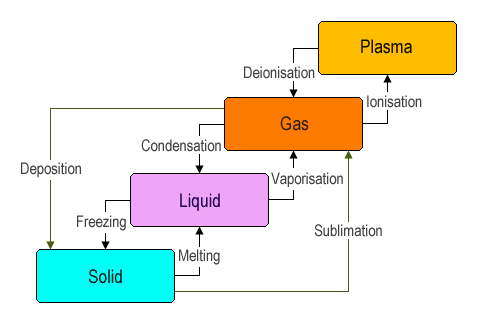
Interconversion of one state of matter to another state of matter is known as phase transition. The three states of matter, i.e. solid, liquid and gas, can interchange into each other under different conditions of temperature and pressure. Let us understand this one by one:

Conversion of solid to
a. Liquids: This process is known as melting. For example, melting of ice cream.

Melting point: It is the temperature at which the solid phase changes to the liquid phase or the temperature at which the solid-liquid state is in equilibrium.

b. Gas: This process is known as sublimation. For example, conversion of solid camphor to vapors.

"Phase transition is a physical process."

Conversion of liquid to
a. Solid: is known as freezing. For example, changing of liquid water to ice.

b. Gas: is known as vaporization. For example, changing of liquid water to water vapor.

Boiling point: The temperature at which the liquid changes to gaseous state or the temperature at which liquid-gas exist in equilibrium.

Conversion of gas to
a. Solid: is known as deposition.
b. Liquid: is known as condensation.


Latent heat of fusion: The amount of heat energy absorbed or released when a solid change to liquids at atmospheric pressure at its melting point is known as latent heat of fusion.
For example, when water changes its phase from solid to liquid, a lot of energy is utilized but the temperature does not change. The energy is consumed but no effect on temperature is visible. Hence, the name latent heat (i.e. hidden heat).

Latent heat of vaporisation: The amount of heat energy absorbed or released when a liquid changes to gaseous at its boiling point is known as latent heat of vaporisation.

Saturday, October 20, 2018

Matter and its states

The matter is anything that has mass and occupies space. Matter exists in different phases, also known as states of matter.
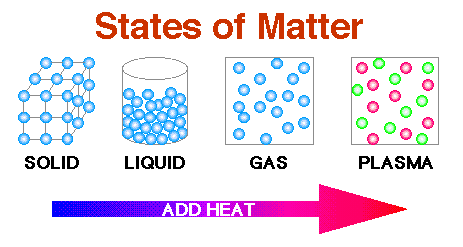
Theoretically, more than 27 states of matter are known, most of which are condensates, i.e., exist at a very low temperature or under drastic conditions. But only 5 states are well-established. These are solid, liquid, gas, plasma and bose-einstein. These are classified according to the force of attraction between the particles.

1. Solid: In this, particles are packed very tightly. As a result, they have
a. strong force of attraction.
b. fixed shape, size, and volume.
c. least compressible.
d. negligible or no diffusion.


2. Liquids: In liquids, particles are packed comparatively loosely. As a result, they do not have strong force of attraction between the particles. They can
a. take the shape of the container in which it is poured.
b. be compressed when pressure is applied.
c. show the process of osmosis.

3. Gas: The particles in gases are very far apart since they have a little force of attraction between the particles. As a result, they are
a. highly compressible.
b. occupy the whole container.
c. highly diffusible.
The liquids and gases are known as fluids (to flow).

4. Plasma: Though this state of matter is not so common on our planet, it is the most common state of matter that is found in our universe. For example, stars, sun etc. Today, various inert gases are ionized using electricity so as to make glowing sign boards.

5. Bose-einstein condensate: In this, the atoms are supercooled to the temperature at which all the molecular motion ceases. At this stage, the atoms start to join together and form a cluster of atoms known as a super atom. They are also known as superfluids as they can flow without friction.
This state was named after two renown scientist, i.e., Albert Einstein and Satyendra Nath Bose.

"Vapour is not a state of matter."

Vapour is an equilibrium state between the gaseous state and the liquid or solid state, which can come back to its original state when pressure is applied on it, keeping the temperature constant or at standard condition of pressure and temperature.

*Description of every state will be posted later in this blog.

Sunday, October 14, 2018

WHAT IS CHEMISTRY?

Chemistry is the branch of science which deals with the study of matter and its interaction either with another matter or with the wave.

When matter interacts with matter, physical and chemical changes occur. For example, when we make tea, we mix milk and water. But in doing so, no new substance is formed and it is called a physical change. Then, we add tea leaves and boil this mixture. We observe a change in colour, odour, taste etc. because a new product is formed. Hence, it is known as a chemical change. In this, the water, milk, and tea leaves are all matter and they interact with each other to form a new product.

The matter can also interact with the waves and as a result, the chemical reaction occurs. A common example is the use of microwave ovens for cooking food. Food, a matter, and the radiations from microwave ovens interact with each other and a new substance is formed.
Being a chemist or a chemistry student, it is our work to study all these changes so as to know the basic nature of each and every particle in the universe.

" Chemistry is the study of matter."

Chemistry works in combination with other disciplines. It makes use of logic and reasoning, mathematics, physics, biology, geology etc. Some common relationships are given below.

With mathematics:  for solving numerical, for preparing solutions of various concentrations.

With physics: there are many laws in physics which we use in chemistry, like Law of Conservation of Mass/Energy, Or quantum mechanics, radioactivity etc.

With biology: by using chemical laws and reactions, we make so many products which are useful in our daily life. Also, some of the products affect the lives of other organisms. For example, the use of DDT as a pesticide.

With geology: it is useful in the study of metallurgy for mining and extracting minerals from ores.

With logic: Every science needs logic to work. If something is not logical, it is beyond our mind.

" Chemistry is known as the central science."

Separation of Components of Air

Air is a homogeneous mixture of various gases. It can be separated into its components by fractional distillation.  Procedure:  Firs...